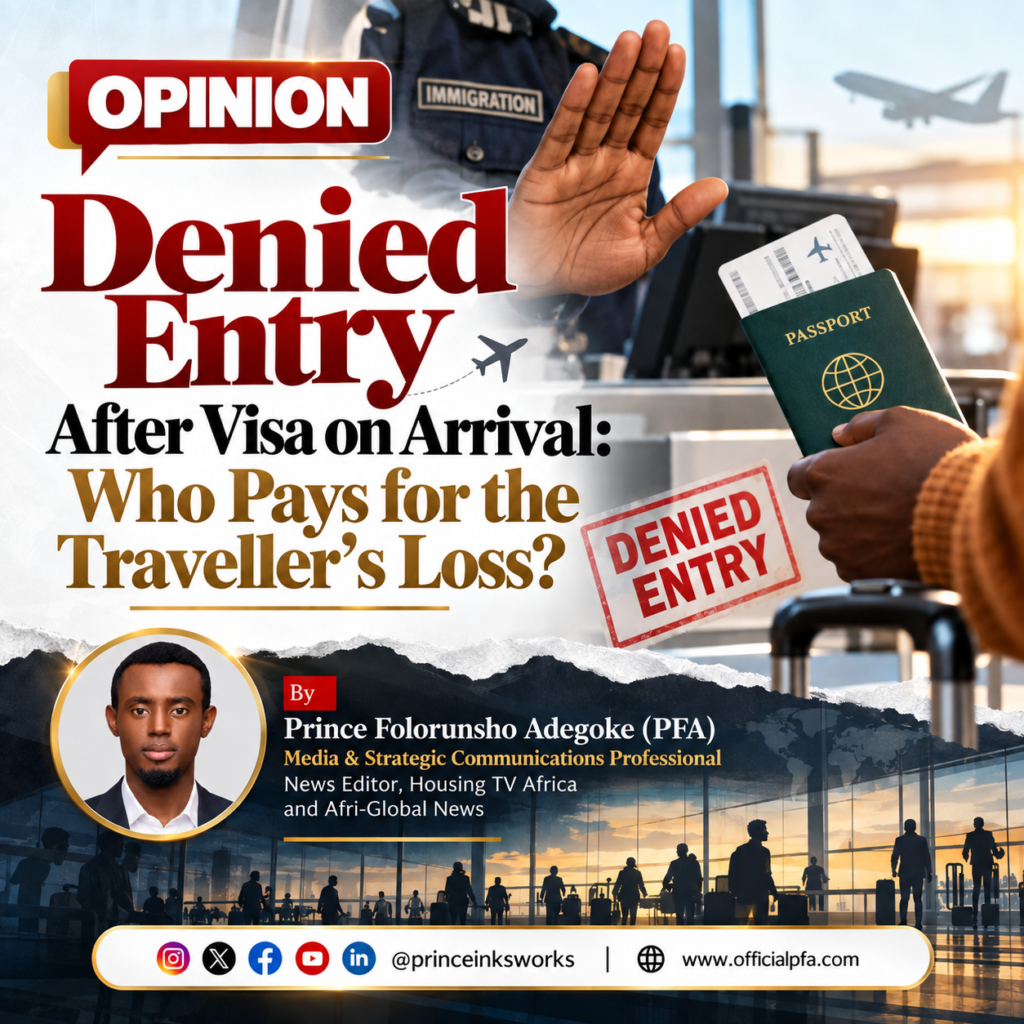
Visa on Arrival Was Meant to Make Travel Easier. What Happens When the Border Says No?
A travel option designed to make international movement easier can leave ordinary travellers carrying the financial, emotional and logistical consequences when entry is refused at the border.
Prince Folorunsho Adegoke is a media professional and journalist with experience in digital, television and print journalism. He covers Nigerian affairs, African development, international relations, housing and economic issues.
There is a painful moment that many international travellers never imagine when they book a flight. After months of saving, planning and preparing for a holiday, business trip, family visit or special event, they arrive at their destination expecting a relatively straightforward immigration process. Instead, they are pulled aside, questioned repeatedly and eventually told that they cannot enter the country.
For such travellers, the disappointment is only the beginning. The flight has already been paid for, accommodation may have been booked and paid for, tours or events may have been arranged, airport transfers may have been purchased and other expenses may have accumulated. Suddenly, a journey that was supposed to create memories becomes a financial and emotional ordeal.
This is where the debate around Visa on Arrival (VoA) deserves much greater attention. The system is often presented as a convenient alternative to the traditional visa process. For eligible travellers, it can reduce paperwork and eliminate the need to visit an embassy before departure. But there is a crucial distinction that travellers need to understand: a visa or travel authorisation does not necessarily guarantee admission into a country. International aviation guidance recognises that the final decision on entry can still rest with immigration authorities at the border, depending on national law and applicable entry conditions. (icao.int)
The question, therefore, is not whether countries should control their borders. They absolutely should. The more difficult question is what happens to the traveller who has relied on a supposedly convenient entry arrangement, spent substantial amounts of money and then finds out at the border that admission is not guaranteed.
When Convenience Becomes Risk
Visa on arrival is attractive because it appears to remove one of the biggest obstacles to international travel. Instead of applying weeks or months ahead at an embassy, an eligible traveller may be able to complete the required process upon arrival.
That convenience, however, can create a false sense of certainty. A traveller may interpret the availability of visa on arrival as confirmation that getting into the country will be relatively straightforward. In reality, immigration authorities can still examine the traveller’s purpose, documentation, financial circumstances, accommodation, onward travel and other conditions before making a final decision.
This distinction is extremely important because the financial commitment usually comes before the border decision. By the time a traveller reaches the immigration desk, they may already have spent a substantial portion of their savings.
That is where the system becomes uncomfortable. The immigration authority has the power to refuse admission, while the traveller is left to deal with the consequences of a decision made after the money has already been spent.
Who Pays When the Traveller Is Turned Away?
Consider someone who has saved for months to take a two-week holiday abroad. The person purchases an international flight, books a hotel, pays for transportation and reserves activities at the destination. Perhaps the traveller has also bought travel insurance, exchanged currency and taken time away from work.
Then, after landing, immigration authorities refuse entry.
What happens to all that money?
The answer depends on the individual contracts and policies involved. Some hotels may provide refunds. Others may retain cancellation fees. Airlines have their own rules. Tour operators may have non-refundable arrangements. Insurance policies may cover some unexpected events while excluding others, including certain immigration-related circumstances.
But one thing is clear: the traveller can suffer a significant financial loss even though the person never entered the country.
For a wealthy traveller, losing a few thousand dollars may be frustrating. For an ordinary African traveller who has spent years saving for an international trip, the same loss can be devastating. It could represent school fees, rent, business capital, medical expenses or savings that took years to accumulate.
This is why denied entry should not be viewed only as an immigration statistic. Behind every refusal is a human being who may have made a significant financial commitment based on an expectation that the journey would proceed normally.
The Hidden Cost: Emotional and Psychological Trauma
The financial consequences are only one part of the story. There is also the psychological impact of being refused entry after travelling thousands of kilometres.
Imagine arriving in an unfamiliar airport and suddenly being separated from other passengers. You may be taken for additional questioning and asked to explain your travel plans in detail. You may be trying to contact relatives, friends, your hotel or your travel agent while immigration authorities determine what happens next.
The uncertainty can be frightening, particularly for someone who has never experienced such a situation before. A person who travelled with excitement can suddenly find themselves feeling humiliated, anxious or helpless.
The experience can be particularly difficult when the traveller believes that all the necessary preparations were made before departure. They may have a valid passport, a return ticket, accommodation and sufficient funds, yet still fail to satisfy the immigration officer at the border.
Whatever the legal basis for the refusal, the emotional consequences can remain long after the traveller returns home.
A trip that was supposed to be a celebration may become a source of anxiety. A first international holiday may become someone’s reason for being afraid to travel again. In serious cases, an unexpected immigration experience can become a deeply distressing personal memory.
“You Should Have Checked” Is Not Always Enough
There is a legitimate argument that travellers must take responsibility for understanding the entry requirements of the countries they intend to visit. Anyone planning international travel should check official immigration information, confirm passport validity, understand visa requirements and ensure that documents supporting the purpose of the trip are available.
Travellers should not assume that because a country offers visa on arrival, they can simply arrive without preparation.
They may need evidence of accommodation, proof of onward travel, sufficient funds, an invitation letter or other documents. Requirements differ significantly between countries, and immigration rules can change without much notice.
But the phrase “you should have checked” becomes less satisfactory when a traveller has actually checked the published requirements and believes they have complied with them, only to face a refusal at the border.
That is where greater transparency becomes necessary.
The traveller should know before purchasing an expensive ticket that satisfying the published visa requirements may still not guarantee admission. That information should not be hidden in complicated immigration language that ordinary travellers struggle to understand.
The Difference Between a Visa and Entry
One of the biggest misunderstandings surrounding international travel is the assumption that obtaining a visa automatically means a person has been granted entry.
It does not necessarily work that way.
A visa generally permits a traveller to present themselves for admission. Border officials can still assess whether the traveller meets the conditions for entry under the country’s laws.
This distinction is legitimate from a national-security and immigration-control perspective. Countries need the ability to prevent people who may pose security, immigration or public-safety risks from entering their territory.
But the same distinction creates a responsibility for governments to communicate the risk clearly.
A traveller should not read “Visa on Arrival Available” and assume that it means “Entry Guaranteed.”
Those are two very different things.
The Information Gap Is Part of the Problem
The real challenge is often the information gap between immigration policy and ordinary travellers.
A government may publish extensive regulations on its immigration website, but many travellers will encounter the information through airline booking platforms, travel agencies, social media or third-party websites.
Some of those sources may simplify the process to a single sentence: “Visa on arrival available.”
That description may be technically correct while still leaving out the most important warning.
The better message would be that visa on arrival is available to eligible travellers subject to the country’s entry requirements and final admission decision at the border.
That wording may sound like a minor technical qualification. To someone who has just lost millions of naira after being refused entry, it is anything but minor.
Airlines and Travel Agencies Have a Role
Airlines also have an important role to play because they are often the first point of contact between travellers and international entry requirements.
Passengers travelling under visa-on-arrival arrangements should receive clear information before boarding. They should be reminded that eligibility for visa on arrival does not necessarily mean automatic admission.
Travel agencies should provide the same warning.
This is particularly important for first-time international travellers who may not understand the difference between visa eligibility, visa issuance and admission at the border.
A simple warning before departure cannot eliminate immigration risk. But it can help travellers make more informed decisions before committing their money.
What About Travel Insurance?
Travel insurance is another area that deserves closer examination.
Many travellers purchase insurance believing that it protects them against unexpected problems during their journey. But policies differ, and travellers should not assume that immigration refusal automatically qualifies for compensation.
Does the policy cover a denied-entry situation? Does it cover non-refundable accommodation? Does it cover additional transportation costs? Does it provide legal or emergency assistance? The answer depends on the terms of the particular policy.
Insurance companies should make these limitations clearer.
Travellers should also read their policies before departure instead of discovering exclusions after an immigration problem has occurred.
The African Traveller Faces a Particular Challenge
For many Africans, international travel is already an expensive undertaking.
The cost of obtaining passports, paying visa or travel-processing fees, buying international flights, securing accommodation and converting currency can make even a short trip financially significant.
A denied-entry experience can therefore have consequences far beyond the individual traveller.
Someone may have borrowed money to finance the trip. Another person may have saved gradually from a monthly salary. A small business owner may have used part of the company’s resources for a trade visit. A family may have pooled money to send a relative abroad for a special occasion.
When that traveller is refused entry, the loss does not necessarily end with the traveller.
Families can feel the consequences.
Businesses can lose money.
People can return home with debts that did not exist before the journey.
This is why immigration policy must be discussed alongside traveller protection and consumer awareness.
Border Security and Traveller Rights Can Coexist
None of this means countries should surrender their right to control their borders.
Immigration authorities must be able to investigate suspicious travel, prevent illegal migration, combat trafficking and protect national security.
A traveller who genuinely fails to meet the conditions for admission cannot reasonably expect an automatic right to enter simply because they have purchased a plane ticket.
But border control and traveller protection do not have to be opposing ideas.
A country can maintain strict immigration controls while providing clear information, transparent procedures and reasonable explanations to people whose entry is refused.
The issue is not whether an immigration officer should have discretion.
The issue is whether the traveller understands the extent of that discretion before spending substantial amounts of money.
The Question of Refunds
This also raises a difficult consumer-protection question.
When someone is refused entry, should there be circumstances in which certain travel-related losses are refundable?
There is no simple universal answer because hotels, airlines, tour operators and insurers operate under different contracts and national laws.
But governments, airlines and the travel industry should at least consider whether travellers need better protection from the financial consequences of border decisions.
If a country actively promotes visa on arrival as a tourism or business facilitation measure, it should also ensure that prospective visitors understand the financial risks attached to the arrangement.
The traveller should not be the only person carrying the consequences of a system designed to facilitate international movement.
Visa on Arrival Should Be a Relief, Not a Burden
The original idea behind visa on arrival is sensible. It can make international travel easier, reduce bureaucracy and encourage tourism, business and cultural exchange.
But convenience loses its meaning when the traveller discovers the most important limitation only after arriving at the border.
A visa-on-arrival system should therefore be accompanied by clear information about eligibility, documentation, financial requirements, onward travel, accommodation and the possibility of refusal.
The information should be available before the traveller buys a ticket, not after the traveller has landed.
Airlines, travel agencies and booking platforms should reinforce that message.
Insurance companies should clearly explain what they cover.
And travellers must take responsibility for checking official requirements rather than relying solely on social-media advice or travel agents.
So, Who Bears the Loss?
When a traveller is denied entry, the immediate financial burden often falls on the traveller.
The government may have exercised its legal immigration authority. The airline may have fulfilled its transportation contract. The hotel may enforce its cancellation policy. The insurer may point to an exclusion.
Each party may have a legal or contractual explanation.
But the traveller remains at the centre of the loss.
The person loses the holiday, the business opportunity, the event or the family visit. The person may lose non-refundable money. The person may have to arrange an unexpected return journey and explain the experience to relatives or colleagues.
And perhaps most importantly, the person may return home carrying an experience that cannot be measured in naira, dollars or euros.
The financial loss can be calculated.
The emotional loss is much harder to measure.
We Need a Better Conversation About International Travel
Nor should travellers expect immigration authorities to admit everyone who arrives at a border.
The answer is greater transparency.
Travellers need to understand exactly what visa on arrival means before they commit their money. Governments need to communicate their requirements in language ordinary people can understand. Airlines and travel agencies need to warn passengers about the difference between eligibility and guaranteed admission.
And when people are refused entry, there should be clear information about the process, their rights, their obligations and what happens to them next.
International travel should involve reasonable preparation and reasonable risk.
It should not involve discovering the biggest risk only after the traveller has crossed half the world.
Visa on arrival was created to make movement easier.
It should remain a relief, not quietly become a burden.
Because behind every passport is a person. Behind every journey is a financial sacrifice. And behind many international trips is a family that has saved for months or years to make that journey possible.
When the border says no, the question should not end with “Why was the traveller refused?”
We should also ask:
Who bears the loss, and did the traveller have a fair opportunity to understand that risk before boarding the plane?