



Sometimes, an organization communicates its culture more effectively through a job advert than through its carefully written corporate profile.
I saw a vacancy announcement on the social media X that made me pause, read it again, and briefly wonder whether the organization was recruiting a staff member or looking for someone to donate their entire existence.
Let us examine the offer.
A. work from 7:00 a.m. to 6:00 p.m.
B. Monday to Saturday, one Sunday every month
C. No sleeping on duty.
D. No unnecessary phone calls.
E, No excuses.
F. Salary, 60,000 Naira.
G. Lunch will be provided.
H. Location, Lekki, Lagos.
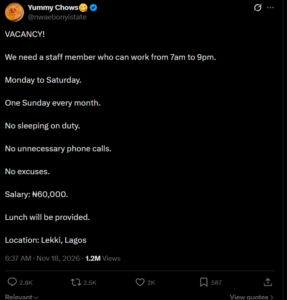
I particularly like the confidence with which the salary was presented, 60,000 Naira. Full stop. Lunch included, as though the organization had just announced a generous welfare package.
Fourteen hours a day, six days a week. That is 84 hours every week, excluding the additional Sunday shifts. At approximately 364 working hours a month, salary works out at about 165 Naira per hour, before even accounting for the additional Sunday.
But no wahala nau, shebi lunch is provided.
Perhaps the successful candidate should also be grateful that the organization has not requested payment for the privilege of working there.
This is the reality of the Nigerian labor market, where survival is a job requirement and employment is sometimes presented as a favor.
Nigeria is difficult enough to survive in without employers turning the desperation for employment into a recruitment strategy. People have rent to pay, transport fares to settle, electricity bills, data subscriptions, family responsibilities, food, healthcare, and a lot more.
A worker in Lekki earning 60,000 Naira will still need to figure out how to get to work, get home, feed themselves outside the promised lunch arrangement, and maintain some semblance of a personal life.
What exactly is the organization expecting this person to do with the remaining 10 hours of the day? And the instruction, “No unnecessary phone calls,” deserves its own award. 14 hours at work, six days a week, but no “unnecessary phone call”. Apparently, the organization wants an employee who is permanently available to the business, but whose personal life must remain permanently unavailable to them.
Beautiful arrangement, but here is a communication lesson that job seekers should not miss.
A vacancy announcement is not just an invitation to apply. It is a communication document. It tells prospective employees something about the organization, its values, its management’s philosophy, and how it understands the employment relationship.
Sometimes, an organization communicates its culture more effectively through a job advert than through its carefully written corporate profile. When an employer openly advertises 84 working hours weekly for 60,000 Naira, it has communicated something. The question is whether job seekers are paying attention.
Dear job seekers, please learn to read beyond the job title. A fancy designation does not automatically mean a good opportunity. A beautiful office does guarantee a healthy workplace, and the promise of lunch should not distract you from an employment arrangement that leaves you with barely enough time to enjoy it.
Before accepting an offer, ask questions. What exactly are the working hours? What are the agreed rest days? Is overtime compensated? What happens when the organization requires additional hours? What are the actual responsibilities? Are transport allowances and other benefits provided? What does the employment contract say?
Please ask these questions. Do not be so eager to impress an interviewer that you forget you’re also assessing the organization. An interview is not an audition for servitude, but both parties are evaluating whether they can establish a mutually beneficial working relationship.
To employers reading this, your recruitment communication is part of your corporate reputation. You cannot continuously talk about productivity, excellence, employee commitment, and organizational growth while designing working arrangements that leave employees with little room to live.
People are not rechargeable office equipment. They have families, responsibilities, health needs, ambitions, and some live outside your premises. If your business requires someone to work 84 hours every week, perhaps the problem is not that Nigerians are unwilling to work. Perhaps your staffing structure, remuneration model, and expectations need a serious review.
There is a reason organizations invest in employee engagement, retention, and workplace wellbeing. People perform better when they are treated as human beings, not expendable resources. And no, providing lunch does not automatically make an unattractive employment offer attractive.
I understand that unemployment is real. People need jobs, and sometimes circumstances force people to accept conditions they would ordinarily question but we must be careful not to normalize every employment offer simply because somebody is desperate enough to accept it.
Employers must understand that recruitment is a two-way conversation. Job seekers must understand that accepting a job should not mean surrendering their right to reasonable working conditions. And maybe organizations should remember that the people they employ are the same people who keep their businesses running. You cannot build a sustainable organization by exhausting the very people expected to sustain it.
One last question. If an organization needs an employee for 14 hours a day, six days a week, what exactly is preventing it from employing two people? Could it be that the organization has a staffing problem, but would rather make it an employee’s personal sacrifice?
if lunch is the biggest selling point of your employment offer, you may want to revisit your recruitment strategy.