


Why has Chatham House, London become like a pilgrimage destination for our politicians
Apparently, when there is a desire to have an important conversation about Nigeria, London is increasingly a preferred address. But here is the question I cannot shake off.
What happened to the Nigerian Institute of International Affairs, NIIA?
Why does it appear that our political class is more enthusiastic about taking important conversations to a British institution? Have we, somewhere along the line, developed an unhealthy psychological dependence on foreign validation?
I’m not suggesting that Nigerian politicians should not engage international audiences. Far from it but shouldn’t we be equally intentional about strengthening the institutions we have at home?
Now to the recent London drama.
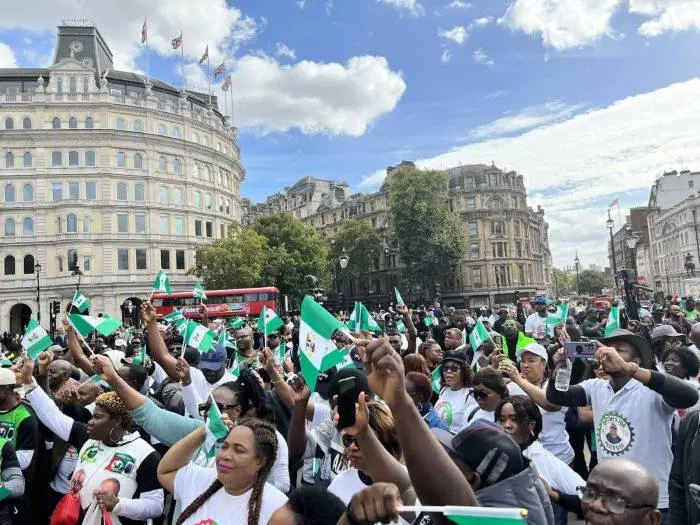
The confrontation involving the INEC chairman and Nigerian protestors outside Chatham House has opened another uncomfortable conversation about civic engagement.
The protestors reportedly raised concerns about the credibility of the preliminary voters register, and the commission’s preparedness for the 2027 elections. These are legitimate matters for public scrutiny. Elections are too important to be treated as a private affair between INEC and politicians.
However, how we communicate our grievances matters. A peaceful protest is a democratic right. Questioning public officials and demanding transparency is not an act of disloyalty to the country but surrounding an official’s vehicle with barricades, shouting at them, obstructing his movement, and demanding that he come out to face an angry crowd raises a different question.
What exactly is the communication objective? Is it to obtain answers, secure commitment, demand accountability, or produce a viral video? Because these are not necessarily the same things. There is a difference between being heard and creating a spectacle.
If the protesters had a list of concerns, why not formally present those demands to the chairman, request a documented response, and make the exchange public? Before anyone misunderstands me, this is not an argument for giving INEC a free pass. The INEC chairman must be accountable for the institution’s action under his leadership.
Public officers must understand that holding an office does not place them above scrutiny and citizens have a responsibility to make their demands in ways that advance the issues they want addressed.
We seem to have normalized two troubling habits: seeking foreign validation for conversations we should be building at home, and confusing the volume of our outrage with the strength of our argument. We must ditch both habits. Until then, we may keep flying our political arguments abroad while struggling to build the democratic culture we desperately need at home.