Taiwo is a Certified SEO Specialist and digital marketing expert with four years of experience in SEO strategy, keyword research, content optimization, and website analytics. Through data-driven SEO techniques, he has successfully increased organic traffic, improved search rankings, and enhanced brand visibility in many reputable news agencies.
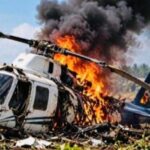
Nine people have died after a private business jet crashed near a residential community in Palm Beach County, Florida, in the United States.
The Learjet 60 crashed on Sunday, November 1, near Military Trail in the Greenacres area, close to Lake Worth Beach. The aircraft had departed Austin-Bergstrom International Airport in Texas for North Eleuthera Airport in the Bahamas, Blueprint reports.
US Transportation Secretary Sean Duffy confirmed that all nine people aboard the aircraft died, describing the incident as a horrific tragedy.
The aircraft reportedly crashed at about 12:50 p.m. local time, striking the ground beside a roadway before bursting into flames. The impact created a large crater and scattered debris across the surrounding area.
The crash triggered an emergency response involving local police, firefighters and rescue personnel. Authorities also evacuated about 600 residents from a nearby mobile-home community as a precaution. Officials moved displaced residents to temporary shelters.
Florida Governor Ron DeSantis visited the crash site and described the scale of the destruction.
“When you see that video, it’s a jarring thing. It was like a missile coming down, and a massive explosion, debris going everywhere,” he said.
Despite the aircraft crashing near homes and a busy road, officials reported no immediate casualties among people on the ground.
Pilot Reported Icing And Turbulence Before Crash
Air traffic control recordings have provided details of the aircraft’s final communications before the crash.
According to the recordings, the pilot initially reported icing conditions and moderate turbulence while seeking a smoother flight path.
The crew also reported encountering precipitation and requested permission to climb to a higher altitude in search of better conditions.
However, the situation reportedly deteriorated rapidly.
The pilot subsequently declared an emergency, reporting that the aircraft was descending at approximately 10,000 feet per minute. The reported descent rate later increased to about 20,000 feet per minute, while the aircraft experienced a steep bank.
During one of the final communications, the pilot warned air traffic controllers that the aircraft was heading towards the ground.
Flight-tracking information reviewed after the accident indicated that the jet’s vertical descent rate exceeded 32,000 feet per minute at one point.
Investigators have yet to establish what caused the aircraft’s sudden loss of control. They are expected to examine whether icing, turbulence, precipitation or another technical or operational factor contributed to the crash.
Heavy rainfall and thunderstorms affected the area around the time of the incident. However, the reported weather conditions do not independently establish the cause.
NTSB, FAA Begin Crash Investigation
The National Transportation Safety Board (NTSB) has launched an investigation, with support from the Federal Aviation Administration (FAA).
Investigators are expected to examine the wreckage, aircraft maintenance records, flight data, weather conditions, air traffic control communications and the crew’s actions before the crash.
Authorities identified the aircraft as a Bombardier Learjet 60, a twin-engine business jet. Registration records listed its owner as a Delaware-based corporation.
Aircraft manufacturer Bombardier said it would cooperate with the investigation and provide assistance where necessary.
Authorities had not publicly released the identities of the nine victims in initial reports.
The investigation will seek to establish the sequence of events that led to the aircraft’s rapid descent and determine whether mechanical failure, weather conditions, human factors or a combination of circumstances contributed to the tragedy.
Six Die In Separate Business Jet Crash In Maine
The Florida accident follows another fatal business aviation crash in the United States earlier in 2026.
In January, six people, including the pilot and co-pilot, died when a Bombardier Challenger 650 crashed shortly after taking off from Bangor International Airport in Maine.
The aircraft had arrived from Houston, Texas, and was scheduled to continue on a transatlantic journey to France after refuelling.
The crash occurred on January 25 during departure in difficult winter weather, with snowfall and temperatures around minus 16 degrees Celsius.
Investigators found that the aircraft had received de-icing and anti-icing treatment before take-off. However, the interval between the treatment and departure, alongside the prevailing snowfall and freezing conditions, became a major focus of the investigation.
The aircraft reportedly veered off the runway, broke apart and caught fire. All six occupants died.
The NTSB’s investigation has examined the aircraft’s flight recorders, de-icing procedures, airport operations and the possible effects of ice contamination on its wings.
One Dead In Texas Private Jet Crash
Another major business aviation accident occurred on June 16, when a Cessna Citation Latitude operated by NetJets crashed onto a highway near Laredo, Texas.
The aircraft was travelling from San José del Cabo in Mexico to Austin and carrying six people when it encountered an emergency and attempted to land on the Bob Bullock Loop.
The jet struck roadside infrastructure and a vehicle before coming to rest on its side near an overpass.
One passenger died, while the captain sustained serious injuries. Other occupants also suffered varying degrees of injury. A person inside a vehicle was reportedly injured.
The incident attracted attention after motorists and bystanders rushed to help passengers escape from the burning aircraft.
An NTSB investigation identified an unusual vibration during the flight. Subsequent examination also revealed damage to components associated with the aircraft’s right engine, including a fractured fuel tube assembly and problems involving the starter generator.
Investigators recovered the flight data and cockpit voice recorders for further examination.
Unlike the Florida and Maine accidents, the Laredo incident did not kill everyone aboard. However, it renewed attention on the risks associated with emergencies involving private business aircraft.
US Business Aviation Safety Faces Renewed Scrutiny
The three incidents have renewed attention on business aviation safety in the United States, particularly aircraft maintenance, weather-related operational decisions, emergency procedures and regulatory oversight.
Private and business jets operate under different ownership and charter arrangements but remain subject to federal aviation safety requirements.
Their operations also involve risks linked to aircraft condition, crew experience, weather assessment and decisions made during emergencies.
Although the three accidents occurred under different circumstances, investigators must establish their specific causes rather than assume they share a common explanation.
For the Florida crash, the immediate priority is determining why the Learjet entered an extreme descent after its crew reported icing and turbulence.
The NTSB’s findings will help establish whether weather-related difficulties, mechanical problems, operational decisions or other factors contributed to the tragedy. The investigation may also lead to safety recommendations to help prevent similar accidents.