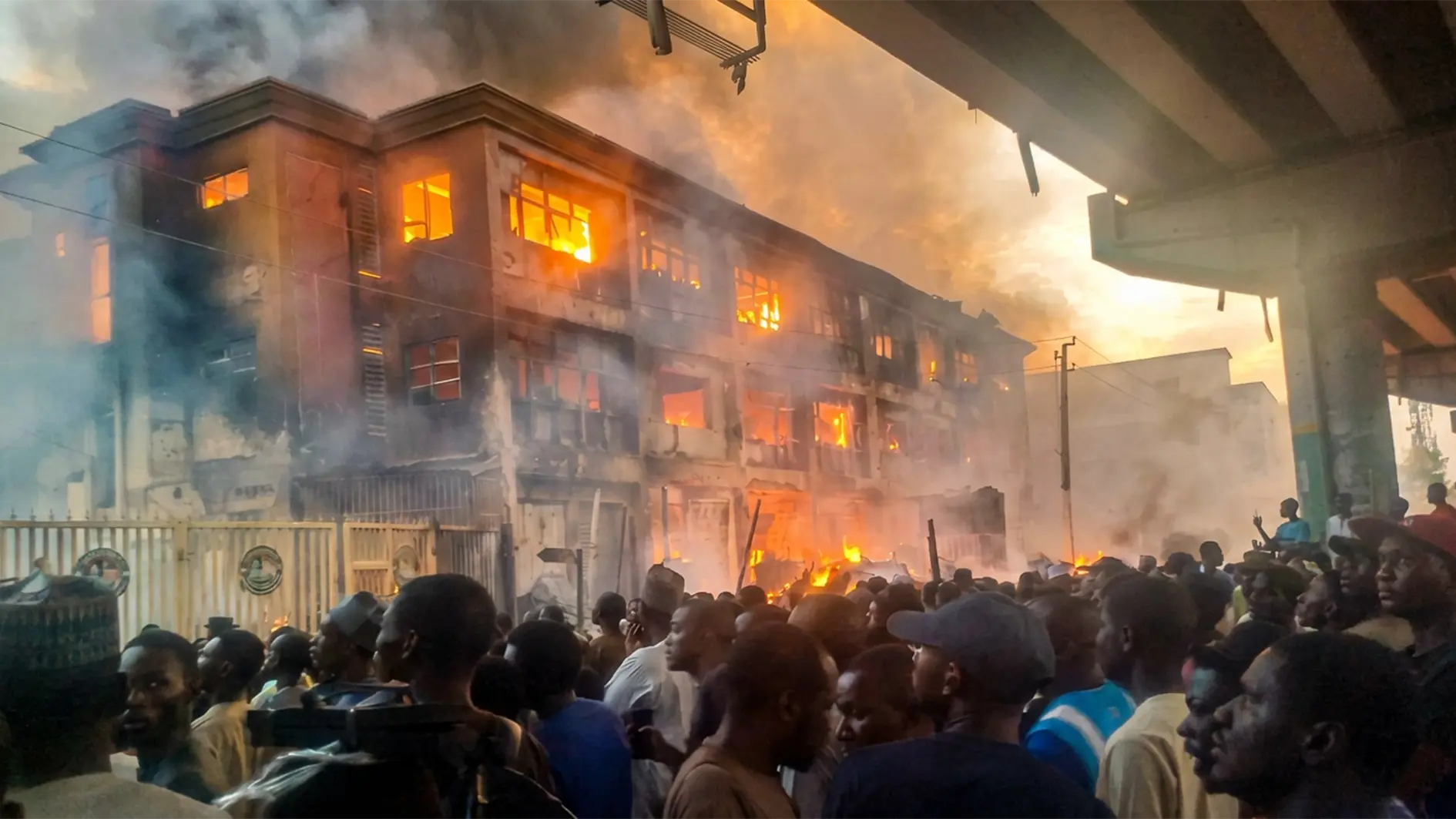



A fire outbreak at Kofar Ruwa Timber Market in Kano State has destroyed 110 structures, including 75 permanent buildings and 35 temporary structures, leaving traders with significant losses.
The inferno occurred on Saturday morning, October 31, 2026, as flames swept through sections of the market, destroying business premises and goods.
The Kano State Fire Service confirmed the incident in a statement issued by its Public Relations Officer, PFS Kabiru Isah Jafaru.
Jafaru said the agency received a distress call at about 7:39 a.m. from a timber dealer identified as Alhaji Abba.
He explained that firefighters from different stations across Kano metropolis were immediately deployed to the scene.
According to him, the fire had spread to several sections of the market before emergency teams arrived, causing extensive damage.
Firefighters eventually brought the situation under control and prevented the flames from spreading to other sections of the market.
The authorities have yet to establish the cause of the outbreak or determine the total value of the destroyed property.
The Fire Service urged traders and business owners to adopt appropriate fire-prevention measures, particularly as the harmattan season approaches.
Kano Markets Record Repeated Fire Outbreaks
The Kofar Ruwa incident is the latest in a series of market fires recorded in Kano this year.
One of the most devastating occurred at the popular Singer Market in February, when a fire reportedly destroyed more than 1,000 shops and businesses.
Market representatives estimated the losses at over ₦5 billion.
The February 14 inferno affected Gidan Gilas, popularly known as Gidan Mai, a section dominated by provision stores.
The fire spread to adjoining structures, prompting the deployment of the Kano State Fire Service and other emergency responders.
The National Emergency Management Agency (NEMA) coordinated a multi-agency response involving the Kano State Emergency Management Agency, Federal Fire Service, Kano State Fire Service, Nigerian Air Force, private-sector fire units and the Nigerian Red Cross Society.
Barely six days later, another fire engulfed the Fatima Simra Multi-Purpose Market at the Dakata Small Scale and Industry Multi-Purpose Market.
The incident destroyed at least 50 shops, according to reports quoting the Kano Fire Service.
The affected businesses were mainly involved in oil production and the recycling of nylon and plastics.
Earlier, on February 11, fire destroyed 30 permanent shops and 55 temporary stalls at Kasuwar Yan Katako, a timber market in Rijiyar Lemo, Ungogo Local Government Area.
The Kano State Fire Service said the incident occurred at about 4:28 a.m. Three fire trucks from different stations responded to the emergency.
The agency also handled a separate incident at a filling station along Ibrahim Taiwo Road in Fagge, where a petrol tanker caught fire during fuel offloading.
In June, another fire affected the Gwanjo, or Takumbo, second-hand market area along Murtala Mohammed Way in Fagge.
The flames reportedly spread from a salvage yard to neighbouring commercial buildings, damaging goods, offices and storage facilities.
More recently, a September fire at Kofar Wanbai Market destroyed shops, storage facilities and parts of residential buildings.
The Kano State Fire Service said the affected properties included plastic shops and stores, while it attributed the outbreak to a solar power system.
The repeated incidents have raised concerns about fire safety in Kano’s commercial centres, where thousands of traders depend on daily business activities.
Market Fires Spread Beyond Kano
Market fires have also affected several other states this year, destroying goods, disrupting businesses and threatening traders’ livelihoods.
In October, a fire at the Creek Road Market section relocated to Number Three Field in Old Port Harcourt Township, Rivers State, destroyed goods and property worth millions of naira.
The Chairman of Port Harcourt City Local Government Area, Allwell Ihunda, visited the affected traders and promised to establish a committee to assess the damage and identify those requiring assistance.
No deaths were reported, while authorities had yet to establish the cause.
Another October incident affected Kugbo Furniture Market in Abuja, where fire destroyed 21 shops and a vehicle.
NEMA and the Federal Fire Service deployed emergency responders to contain the outbreak and prevent it from spreading to neighbouring properties. No casualties were recorded.
In August, Sabo Market in Ore, Odigbo Local Government Area of Ondo State, suffered another fire outbreak that destroyed shops and goods.
Governor Lucky Aiyedatiwa visited the market, promised government support for affected traders and ordered an investigation.
The state government disclosed that the market had experienced three fire outbreaks within two years.
Earlier in July, fire destroyed several shops at Bode Market in Ibadan, Oyo State.
The herbal section was among the worst-hit areas, leaving traders to assess the damage to their businesses.
In February, Fika Central Market in Yobe State also suffered a midnight fire that destroyed shops, stalls, slaughter slabs and goods worth millions of naira.
The Executive Secretary of the Yobe State Emergency Management Agency, Dr Mohammed Goje, said outdated firefighting equipment hampered efforts to contain the blaze.
The incident renewed concerns about the emergency response capacity of some local fire services.
Traders Face Mounting Financial Losses
Market fires often affect more than the traders whose shops are directly damaged.
Families, employees, suppliers, transporters and other businesses connected to affected commercial centres can also suffer financial consequences.
For many small-scale traders, a fire can destroy years of savings and investment within hours.
Some operate without insurance or access to affordable credit, leaving them with limited resources to restart their businesses.
The impact can also extend to customers and businesses in other states, particularly when major distribution centres suffer disruptions.
Kano remains an important commercial hub supplying traders and businesses across northern Nigeria and neighbouring countries.
Repeated market fires can therefore affect supply chains, employment and the movement of goods beyond the state.
The destruction of more than 1,000 businesses at Singer Market earlier this year demonstrated the scale of the potential economic consequences.
The latest Kofar Ruwa incident adds to the losses already suffered by traders across Kano.
Calls For Stronger Market Fire Prevention Measures
The recurring outbreaks have renewed calls for stronger fire-safety standards, regular inspections of electrical installations and improved emergency response infrastructure.
Markets dealing in timber, plastics, petroleum products and other combustible materials require particular attention because fires can spread rapidly through such environments.
Recommended safety measures include functional fire extinguishers, smoke detectors, accessible emergency exits and properly maintained electrical installations.
Market authorities and traders also need regular safety education and emergency drills.
State governments must ensure that fire stations have operational trucks, adequate water supplies and other essential equipment.
The Kano State Fire Service’s warning about the approaching harmattan season also highlights the importance of preventive action.
However, responsibility for fire prevention cannot rest on traders alone.
Government agencies must enforce building and electrical safety regulations, provide functional fire hydrants and equip emergency responders to handle major incidents.
As traders at Kofar Ruwa begin assessing their losses, the latest disaster highlights the need for sustained investment in market safety.
Without effective prevention and enforcement, recurring fires will continue to threaten businesses, livelihoods and local economies.